
Mānuka honey has become famous around the world.
But here at Cae’r Faban Farm, in the hills of the Conwy Valley, we’re interested in a slightly different question:
What happens when mānuka becomes part of a Welsh landscape?
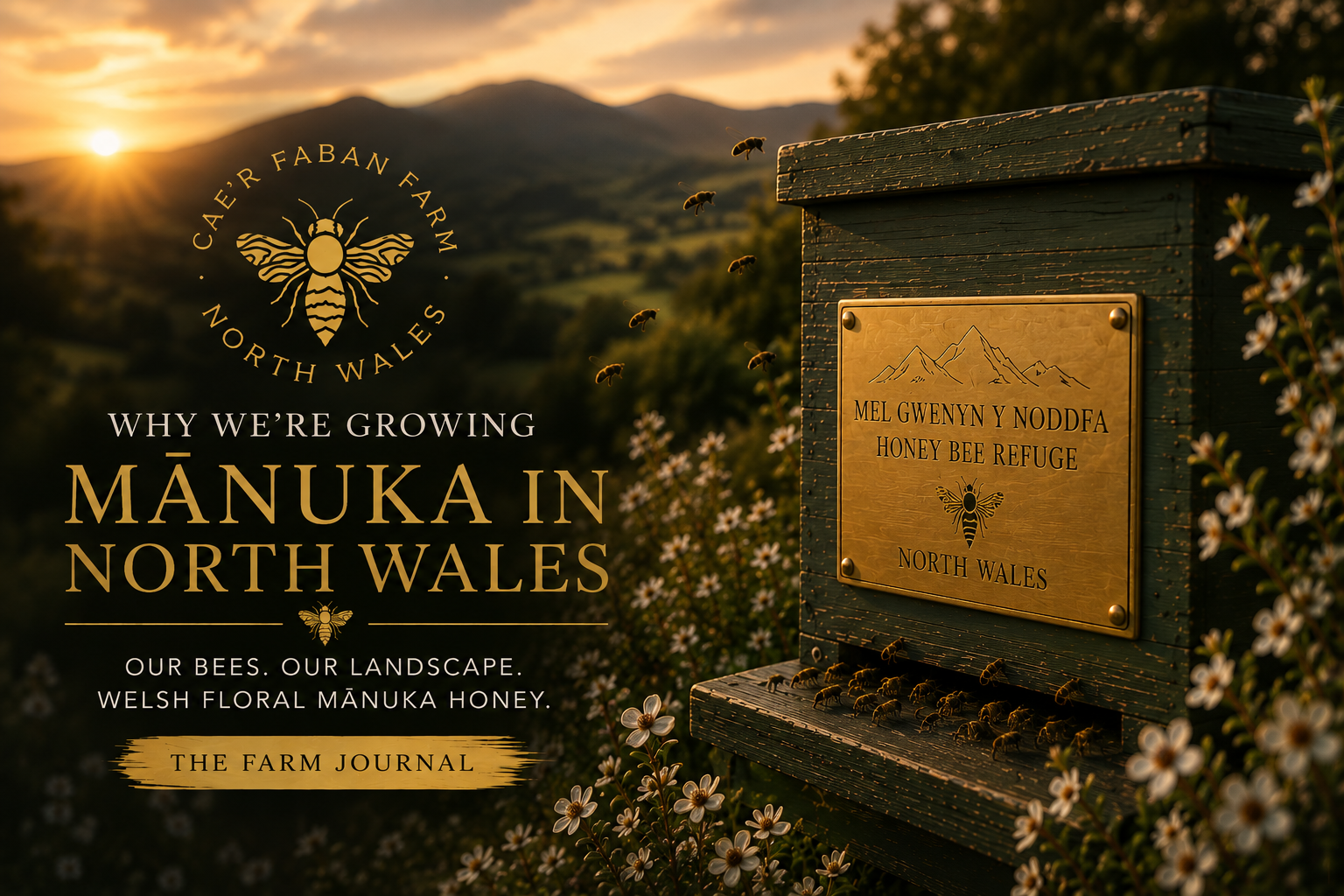
That’s the idea behind our developing Welsh Floral Mānuka Honey and our apiary, Mel Gwenyn y Noddfa — Honey Bee Refuge.
Why “Honey Bee Refuge”?
The word Noddfa means refuge or sanctuary in Welsh.
For us, that word has a particular significance.
Local tradition associated with Cae’r Faban connects the historic site to the conflict around Llanrwst more than a thousand years ago.
The Battle of Llanrwst is generally dated to AD 954, during a turbulent period in Welsh history. The story associated with Cae’r Faban tells of women and children coming here to seek refuge from the fighting.
More than a millennium later, we’re giving the idea of refuge a new purpose.
A refuge then. A refuge now.
Today, we’re creating a refuge for honey bees.
Planting for the Future
We’ve begun establishing mānuka — Leptospermum — at Cae’r Faban as part of a much wider approach to bee forage.
Our bees don’t live on mānuka alone.
They forage freely across the farm and surrounding countryside, visiting whatever nature offers them: wildflowers, hedgerows, trees, orchard blossom and other seasonal sources of nectar and pollen.
That’s precisely what makes the project exciting.
We’re not trying to recreate New Zealand in North Wales.
We’re trying to discover what North Wales can produce.
Welsh Floral Mānuka Honey
That’s why we’ve chosen the description Welsh Floral Mānuka Honey.
The honey should represent the landscape our bees actually forage.
As our mānuka planting matures, it will become another important source of nectar within that landscape, sitting alongside the natural Welsh flora surrounding Cae’r Faban.
The result won’t simply be about a particular plant.
It will be about place.
The Conwy Valley. Our weather. Our flowers. Our bees. Our harvest.
From Hive to Laboratory
We’re also interested in what the science tells us.
As the project develops, we intend to have appropriate harvests independently analysed so we can understand the characteristics of the honey produced by our colonies.
We’d rather test than guess.
If our honey develops particularly interesting properties, we’ll have the evidence to understand and communicate them properly.
Until then, we’ll let the bees — and the laboratory — do the talking.
Every Vintage Tells a Different Story
Honey is an agricultural product, not a factory recipe.
A warm spring followed by a wet summer can produce something completely different from a cool spring and long, dry flowering season.
That’s why our Cae’r Faban honey will be produced in small batches and identified by harvest and vintage.
Each jar becomes a snapshot of the landscape during that particular season.
Some vintages may never be repeated.
We think that’s something worth celebrating.
Building the Refuge
Our ambition for Mel Gwenyn y Noddfa goes beyond producing honey.
We’re continuing to develop the apiary, increase bee-friendly forage and expand our mānuka planting while learning which varieties perform best in our North Wales conditions.
Over time, we want Cae’r Faban to become somewhere genuinely valuable for bees and other pollinators.
And that’s where the ancient story of this place comes full circle.
More than a thousand years ago, according to local tradition, Cae’r Faban offered refuge to people.
Today, we’re creating a refuge of a different kind.
Mel Gwenyn y Noddfa.
Honey Bee Refuge.
A refuge then. A refuge now.
From the hills of North Wales